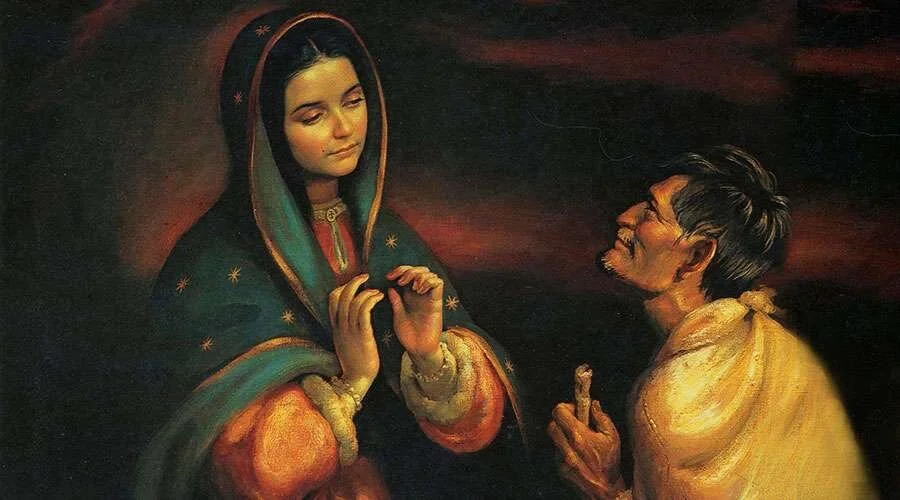
Today the Western Churches commemorate La Virgen de Guadalupe, a Marian apparition to St. Juan Diego in 1531. The veneration of this apparition, centered in Mexican Roman Catholicism, has spread into American Anglicanism as the Latinx population of the Episcopal Church continues to grow. The story is lovely and is told in brief in the Roman Catholic Office of Readings for today. When I do the antecommunion for feasts, I typically use the second reading from the Office of Readings in lieu of a homily. And as I read it this morning, Our Lady’s words to St. Juan Diego pierced my heart in an even deeper way than they have before:
Listen, my beloved son, have no fear or anxiety in your heart [...] For am I not here with you, your mother? Are you not safe in the shadow of my protection? Am I not the source of your life and your happiness? Am I not holding you in my lap, wrapped in my arms? What else can you possibly need? Do not be upset or distressed.
I mean, c’mon—“Am I not holding you in my lap?”—heart-wrenching, right?
I know a lot of Anglicans who come out of the Roman Church look askance at Marian devotion, especially if they are women and/or experienced the pre-conciliar era at all. But even setting aside the Blessed Virgin’s role in my decision to get sober (a involved story for another time), Marian devotion has been pivotal in my Christian faith. There’s certainly the aspect of her as the archetypical priest, which has shaped my sense of priestly vocation and my participation in the Sodality of Mary Mother of Priests. But more particularly has been her role in my life as a queer person of color (QPOC) in the Church.
My particularly intersection of social identities would by no means win the Oppression Olympics that are a regrettable byproduct of Dr. Kimberlé Crenshaw’s intersectionality theory making its way onto social media. But it has left me somewhat bereft of a place within the Church, particularly the Western traditions. My sexuality is not welcome in the Roman Church; my sacramentology (et al.) is alienating to more Protestant-minded Anglicans; and my race is viewed with suspicion in all sectors of American Western Christianity. I don’t recite this litany to elicit pity, but I do want it to point out the precariousness of life as a queer, catholic Christian of color.
The feeling of never quite being welcome in any ecclesial body engenders a loneliness in me (and I think many others in my position), which leads me to turn to the Communion of Saints for spiritual companionship. Among the saints, singing their paeans before the heavenly throne, I am able to find a place of welcome. All stain of racism, sectarianism, and homophobia have been burned away by the Divine Light, and I find great comfort in knowing they view me with no malice, implicit or otherwise.
Chief among these loving companions is the Blessed Virgin Mary. Not only because of the centrality of her discipleship and the resonating influence of her “yes.” She is perhaps most dear to me because with her I find a taste of human family as it ought to be. I am alienated from my mother and the rest of my biological family, largely because of sexuality and religion. And while I find great joy in my family-in-law and chosen family, there’s no earthly replacement for that ineradicable bond between mother and child. The absence of that bond is a gap in the soul that is forever tender to the touch.
So when I hear the Blessed Virgin tell St. Juan Diego that she is his mother… that he is safe in her protection… that he is laid in her lap and wrapped in her arms (!!!)… I see a reflection of that human motherhood that will always be lacking for me this side of the eschaton. In la Virgen de Guadalupe, I see a mother, unbleached by racism, speaking with tenderness to a man who looks a lot like me. Just as I find an ecclesial home among the saints that can only ever be partially realized in this life, in Mary I feel the love that ought to be but cannot because of sin. When I am wearied by the racism, homophobia, and anti-catholicism in the Church I love so dearly, I am able to lay my head in my mother’s lap and hear her say she’s here for me.
It’s a peculiar (perhaps niche) sort of balm for a peculiar sort of pain. But I am grateful for Our Lady and would not be a Christian (or alive) without my relationship with her.
So, nuestra señora de Guadalupe, ruega por me y por todos tus hijxs.